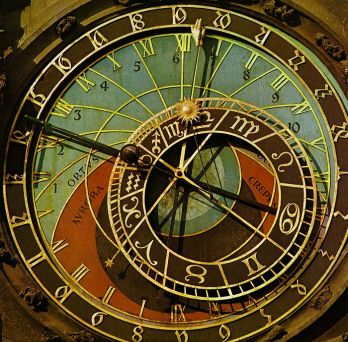
Time Zones Map, Clock
|
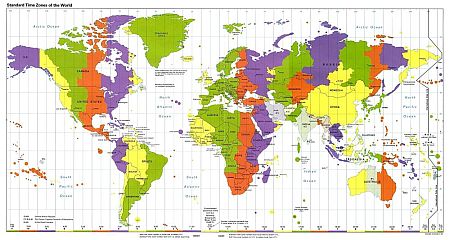
Time Zone Alarm ClocksHelp deliver a job to a customer on another time zone: This page was created for our translators to help them
deliver their (and subsequently
our) work on time. TimeZone Table
Therefore, if something is due at 16:00 (4:00pm) GMT time, and you are located in Volgograd Russia on ZP4 time, you would have to deliver your work by 20:00 (8:00pm) your time (add four hours to the due date, according to the third column in the table above).
What are Time Zones?
Everything is relative. A plant grows. We compare the states "after" and "before", and in our minds we think time. An object moves from point A to point B, or relative to what we call points A and B, the universe shifts around, we call it before and after, and label the "time" it took for that object to move between these two points. For us on earth, our reference point for time is the sun, the most obvious object in our sphere of perception, with its movement "around us". But in fact it is not moving around us, but our earth is spinning. When the created particles exploded outward following the big bang, because they were little particles of mass, they were attracted to each other, because mass objects are attracted to each other by gravity. We can stand on the earth because we are a mass object attracted to the great (relative to us) mass object of the earth. A Chinese person is upside down compared to a US person, because they are on the other side of the planet attracted and drawn by gravity to its centre.
In the same way when these mass particles start to attract to one another during our forming universe, they naturally form a spinning disk, much like with the water going down the drain. This big disk could eventually form a galaxy, universe, or solar system, with the most clusters and mass in the centre of the disk, all of it spinning around. On a solar system level (solar means a sun), the most mass in the centre can form a sun, like ours. There is so much mass that the sheer weight of all these mass particles, attracted to one another under gravity, becomes so great that the pressure eventually ignites and starts a chemical reaction. Under the sheer weight of it all, and pressure, the chemical reaction converts hydrogen and helium back into energy, which we see as light and feel as heat. The mass of our earth is also a lot, and the weight and pressure of this mass is great enough that, if we were to bore a hole 3 km towards the centre of the earth, the pressure and heat would be strong enough to melt all our equipment (which are basically made from the iron ore found in our earth's, cooled crust). We are actually sitting on a very thin crust, the outer layer of the earth, which has cooled down to the point that we can stand on it (although, in the earlier days of the earth's development, the crust was mostly molten lava and exploding volcanoes, and it took a long time to cool down to where it is now). Past 3 km from the surface it is still all molten lava, which occasionally escapes to the surface through volcanoes or large earthquakes. But our earth is not large enough to ignite the reaction which creates energy (which is conversion of mass back into energy) to turn it into a star. But Jupiter has just enough mass to make it a small star. There are other stars in the universe which are such a large collection of mass and produce so much gravity that they do not even let light escape, sucking everything into it. For the same reason that the particles of mass travelling outwards from the initial big bang have drawn together in spinning disks, the hazy mass within the forming and spinning solar systems have also conglomerated into spinning matter, eventually forming spinning planets, now revolving around the sun at the same speed as the forming solar disk was previously spinning. There are two interesting theories regarding the relative distance of the planets from the sun. One was postulated by Galileo < who drew geometric shapes with an increasing number of sides, and found that they perfectly fit into one another <link and add picture> . Another theory < calculates that the relative distances of the planets from the sun correlate exactly with the relative distance between the frequencies of musical notes, whereby F# would be the asteroid belt, and hence deemed an unstable orbit and where a planet could not form properly. This is just one example of the amazing harmony of nature, which one can also consider as proof of the divine existence of God. Therefore, we have our sun in the centre of our own solar system, and our planet spins in an orbit around it, our planet itself spinning around, with the moon spinning in an orbit around us.
This is how the Sumerians defined time. But because the world is a round globe, the beginning of night and day is different depending on where you are located in the world. What is high noon for someone in the US would be pitch black midnight for someone in China, on the other side of the world. Therefore, over time, we humans started to draw imaginary lines on the planet, cutting up the planet into 24 parts, one for each hour of the day. In the days of old, people used a sundial to tell the time, which is basically a solar clock. A little stick at a certain angle which would cast a shadow as the sun, from our perspective, would revolve around our planet. But as humans advanced, and with the invention of railroads (the first time zone GMT was in fact created by British Railways), and transportation becoming faster and faster, it got to a point where it was necessary to set some relative times between each place. So the earth was carved into one hour slices, usually along political borders, or what we humans thought would be the best way. This way, if ever taking a train, you would know exactly what time you should arrive at a certain city, which fell in a certain time zone, subtract or add the number of hours on your clock, and everything started to make better sense for our developing societies. During humanity’s development, the period during all this defining was when England was a great power in the world, controlling many colonies. And with such power during this development, and such a strong naval power, in 1675 they labelled the centre of our time in Greenwich, and defined Greenwich Mean Time (GMT) as the zero time zone to help ships navigate the world and define longitudinal lines, such that the remaining parts of the world were either plus or minus so many hours from this zero point. The sun rises from our west and sets in our east. So if we move along the planet westwards, we are going back in our little created time, towards the morning of the time zone we are moving towards. Likewise, if we fly east, we are flying towards the setting sun, towards the end of the day, and hence we would add time to our clock. But in the big scheme of things, the time in the universe is steady, whereby we are only adding or subtracting hours on our own clock, simply for the convenience of defining for us what is morning and what is evening (in terms of the angle of the sun with reference to the point on the globe that we are stationed at). And if we go far enough west or east, meaning 12 hours in either direction from the GMT zero time, we will end up on the other side of the world from Greenwich England, where we could add or subtract half a day. So on one side of this other imaginary line it is a day later or earlier than on the other side. But this is just how we have divided up things, based on our fingers and the rotation of the earth and sun.
And then we have daylight savings, which is the adding or subtracting of an hour to or from a particular time zone and at a particular time of the year, to help the farmer get up early to begin work in his field. But over time, the farmer did not have such an import or dominant role in society. Some areas use daylight savings while others do not. Recently, the US has shifted the time when it applies daylight savings because it has calculated it can save its economy billions of dollars by not forcing people to use their airconditioners so much at work . So whatever time zone you are located in on this planet, and you are working on a translation assignment for KENAX, let us just agree on a delivery time based on the GMT time zone. Our customer may be in Japan and want the translation delivered by 4pm its time, before the end of its working day. According to the table above, where JST is +9, 4pm would be 7am GMT time. And if you are a translator working in Mexico city, meaning –6 from GMT, you would have to deliver your translation by 1am, or shortly after midnight. As long as everything is delivered on "time" and the customer is happy! And now that you understand how humans perceive time, perhaps you might be interested in how time is perceived in the eyes of God!
Some more of my articles which might interest you
Contact
More time zone links here:The World Clock Some keywords: timezone map, time zones, timezone, timezones, table, time zone table Site put together by KENAX Translating Agency for its translators Time Zone comments:Ok, I have a
question. So if it\'s 6:15 in America and it takes 5 hours to travel to
London, what time would it be in London after those five hours? It depends on which time zone you are in the the way you mix
spirituality and science is incredible :) Thanks, but many scientists believe in God and scientists have done some rudimentary scientific research on psychic powers, for example. Science does not automatically mean a lack of spirituality and many things are connected that we do not understand yet. Think of the unified theory of relativity. There is a spiritual element to our existence, even if one were to deny the existence of God and spirits. What times is
12,00hours ( a day) in New According to the table on this page MST is -7 (7 hours
earlier than
|
| Travel Europe blog Computer Tips |
List of Translation
Agencies |
Copyright © KENAX, by Karel Kosman - All Rights Reserved Worldwide.