Travel Europe blog
When I first came to the Czech Republic, things felt exciting. I imagined that the conversion from communism to capitalism was like turning over one of those glass balls so that it looks like snow is falling on a village. Everything was overturned, things were changing very fast, and everyone seemed to be filled with hope. Even those who came from abroad and who felt hope in developing a successful business here. It was often compared to Paris after the second world war, when the inflow of American money helped create a robust and joyful atmosphere. But over time, many foreigners realised that the bureaucratic headache of accomplishing anything was not worth the effort. Many left, mostly around November to escape another painful winter, but some remained and succeeded, or just loved it there and continued teaching English or some other profession. The early years we called the magic years. There were not many bars for the expats to hang out at, and the people traveling through tended to be the more adventurous and interesting type, so it was easy to meet people and have fun. But this all subsided, Prague lost a lot of its magic for me, people were settling down in their success or lives, and things just didn’t seem so exciting anymore.
When I first came, I must have been the only one to walk up or down the escalators in the metro. It’s as if Czechs grew so accustomed to standing in a line the length of one or two blocks and waiting for their monthly ration of toilet paper that they were in no rush at all. After all, they would say “The Russians can pretend to pay us and we will pretend to work.” But this too slowly changed over time. Very slowly, successful Czech entrepreneurs and professionals were finding less time to stand idly on the escalator, and by the time I left, I’d say half the people were walking and half standing. The rat race finally arrived to the eastern block.
Another thing I noticed in the beginning was a great sense of camaraderie. Under communism, mostly everyone was on the same level and they would all get together in the pub to complain about the government. On the weekends they would go out to the country and sing around the fire. In the city it wasn’t difficult at all to find a group singing Czech songs in the pub. But this too also slowly changed. I clearly remember one time I was on the metro, and two couples who obviously knew each other ran into each other unexpectedly. One couple was very well dressed, while the other was wearing the typically drabby and colourless clothes very common at that time. They gave me the impression that they were close friends at one point, but now they both felt uncomfortable in each others’ presence, considering the new difference in their stature. So the classes were diverging, and so were the people within them, now more concerned with image, material gain, and themselves.
The typical generation gap found under capitalism also formed. Under communism, youngsters had to revere their elders, and if they failed to do that, they spent an appropriate time in the army learning due respect. Retired people often had a higher pension from the state than working university-educated people. Everyone had to serve in the army, and discipline was instilled on every level. But as capitalism replaced the old system, youngsters started to puncture their face with the typical metallic objects, wear protest black, and exercise a general aloofness and disrespect towards the authorities which the previous generation would never dream of.
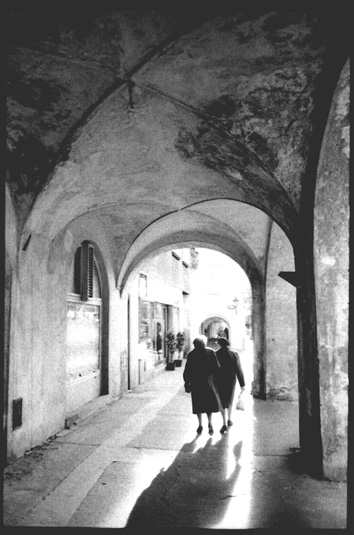
One common occurrence was to hear on every street corner and every bus or tram stop a collection of grannies who would go on and on about the rising price of milk and other basic commodities. How it was absolutely horrible and unheard of, and how so and so shop on such and such street would dare to break the barrier even further and charge so and so much. Of course, under capitalism and in the beginning, it was normal for a state to let inflation run rampant while claiming they lacked the funds to force a proportional increase in the pension handouts, so the elderly population watched defenselessly as their hard worked-for incomes were being eroded before their very eyes. They would often look accusingly and bitterly at me, the well dressed “foreigner”, as if I was somehow to blame for this new injustice.
I must admit that their constant referrals to the incredible price of milk was annoying, and the subject of pub jokes in the evening, but I would never dare to confront them about it, because I sensed their feeling of injustice, and it really made little sense to try and enlighten them regarding the advantages of capitalism over extreme socialism. Trust me, I failed miserably several times with my own grandmother. But I do remember one point when a Czech youngster finally had enough, walked up to one of these groups of grannies like a child stomps towards a flock of pigeons in the middle of a town square, and hollered at the top of his lungs, “ALL RIGHT ALL RIGHT, THE PRICE OF MILK IS HORRIBLE. DO WE HAVE TO KEEP HEARING ABOUT IT?!?” I must admit that, not only was it very satisfying to witness this, but I rarely heard the discussion mentioned after that, and Czech society continued to change altogether.
With open borders also came increased trade, and with the Czech Republic located on the crossroads of trade and history, it became a conduit for all sorts of traffic. In the news I would read of a Czech person caught trying to sell a Russian nuclear weapon out of the back of his car trunk. Trains were stopped at midnight and big black suspicious plastic bags were pulled out from underneath. Drug traffic flourished, and the Bohemian lasse fair nature of Czechs allowed for everything. In the beginning, I would smoke dope freely in any pub or fancy restaurant, and no one had a clue what was happening. Towards the end though, the fancy restaurants would respectfully ask me to go further down the street to a special pub where “that sort of thing” was more appreciated.
In the beginning, many Czechs, especially the older generation, were rather hostile to foreigners, feeling as if their homeland was being invaded by those who benefited from a wealthier upbringing and who could afford to invest into a new business here, or buy property or existing companies. A privatisation scheme was invented whereby all investment certificates covering all national corporations were distributed to the population, but banks and fund companies offered cash in hand for these certificates. Since the average Czech was used to forecasts of a dismal future, they tended to be short sighted and sold their shares for quick gain. Or perhaps some held onto their shares, but with most people selling their certificates, they would get conglomerated by some concern to gain a majority share, after which they could control the company, perhaps go public, and the share price would often not yield any substantial gain for those who actually did hang on to them. So, ironically, the control of Czech companies went from state controlled banks, to the population, and rather quickly back to the same banks, who by this time were privatised and sold into foreign hands.
And generally, the Czechs being possibly the most atheistic of all nations (at 85%), they seemed to lack any grain of shame and, as a foreigner, it was next to impossible to buy even a small bun without some surcharge added to it by profiteering clerks. Special charges not found on the menu seemed to surface, or prices were set blatantly higher for English speaking menus as opposed to Czech ones. The level of cheekiness was appalling, but as Czechs were catching up to the west, I guess they started feeling that this sort of behaviour was beneath themselves, and no longer really necessary, as they soon found themselves better off than the perpetual supply of tourists desperate to stay in the beautiful city by competing against the million other freelance English teachers, or to play their music on the street corners. So this practice generally subsided by the time I had left, but not so difficult to find when one ventured to the country and out of the city, where the traffic of foreigners was still a novelty. However, on a business ethics sense, I’d still say the Czechs have a long way to go, and I hope that the slow enlightenment towards spiritual matters will help in this regard.
In conclusion, Czechs are hard working and industrious. It would not take extremely long before grandparents would be pulling mobile phones out of their pockets to send an sms to their beloved children. And with this increased affluence came a greater tolerance to the foreign element, and more polite manners in general. Under communism, it was the intention of the government to nurture mistrust among the people. Those informing on the suspicious behaviour of their neighbours were rewarded, so many people were rather mistrustful and bitter against one another. By the time I left though, the general behaviour among people seemed much more civilised.
The Czech Personality and Character
When I first wrote this page (above content), it was the beginning of my vast writing published on the internet and I felt some trepidation about being too honest, lest there be some backlash I did not anticipate.  But since then I came to the conclusion that there really wouldn’t be any backlash, I could easily handle any backlash if there were any (which would presumably mostly come from Czechs, who might do well to read these contents and become sober), and I feel I should be honest anyway. So here you have it in full force, although I’ll try to be as neutral as possible.
First of all I’d like to mention that there are good and bad people everywhere. What I will write below is a generalization which, although some would say we should never do, as a world traveler I believe it definitely is possible. After all, in every society it seems the majority is willing to conform to some “accepted (local) standard”. These are the masses of the weak who do not stick to some conviction (they probably don’t have any) but are quick to wear Benetton and act in certain ways so as to be accepted by the most. In which case, given that such voluntary conformation exists by the majority, we can generalize on regional or national levels.
Having said that, I have definitely met a lot of cool Czechs that I love and am great friends with. From what I’ve met, I’d say Moravians are a different breed of people. They are more genuine, straightforward, honest, straight up, and modest.
 Czechs, and substantially more so those living in the capital city of Prague, can be quite dishonest, smug, self-inflated, unethical, and quite envious. But envy can go hand in hand with smugness. If someone has a tendency to self inflate and become smug, they will hate those they envy and who seem better than they. They will feel humiliated next to someone who has more money or is in some way “better”, and use all their ambition, resources and thievery to try and become as “good” as that neighbour, or foreigner. Czechs can be outright shameless in how they would swindle you without a second thought. When I first came to Czech I thought they might be justified because how they themselves were robbed under forty years of Communism. They would constantly cry and moan how their little nation was the sixth most industrial nation in the world between world wars, but how that had all been robbed by the Russians. They were robbed of their great potential to be as well off as Americans or their western European neighbours. And hence they feel fully justified in swindling out of them as much as possible, even if you are just trying to buy a bun with your morning cup of coffee (and speak rather fluent Czech, but with a noticeable accent that reveals you did not suffer the forty years with them).
 However, after traveling in other eastern European countries, I was surprised how genuinely friendly and honest people were there, which is why I reneged on my initial notions of any justification for the Czechs’ behaviour. And I believe all these attributes are related, as I mentioned. Their lack of morality can be attributed to the fact that they are the most atheistic nation in the world, at around 85% of the population. They screw around on each other and have extra marital relations as quickly and without conscience as if they were changing their daily underwear.
Because of their industriousness, talent, ambition to catch up to the west and successful swindling, over time they have indeed substantially caught up to the west, their currency has been increasing steadily against both the Euro and the dollar (not that difficult with the latter), and in time their swindling in Prague has subsided to a surprisingly negligible amount. I guess mostly because they have become “well off enough” and felt that that sort of behaviour is now beneath themselves, and unnecessary. Especially when they see the abundance of derelict expats in Prague, both in the form of tourists and those who have chosen to live there, because this breed can often be shabby in its attire, not be very well off at all, perhaps only teach English for a living, and it would be practically degrading to swindle someone like that. Which is why I assumed most of the waiters in Prague stopped swindling foreigners. Or perhaps because the club scene has become so competitive that managers finally started paying attention to customer care.
I can’t imagine it would be because of some new found ethical streak. I’ve often compared the Czechs to Feringies, that branch of Klingons in the Star Trek New Generation whose decision processes are stimulated solely by profit and not the least drop of morality or conscience.
 But one thing I did like about Czechs is their instinct to back off in any confrontation. If you accidentally rubbed shoulders with them while speedily on your way in pedestrian traffic, they would instinctively turn around, raise their palm in a downward, soothing motion, and say “sorry”. But that may be mostly attributed to their proximity in central Europe, at the cross-roads of history, when one neighbouring giant after another would storm over the territory in their imperial and continental conquests. They simply learned to be subservient and mild mannered. So the cafes are not raging with loud-mouthed American types (unless some Americans are present), and they generally behave quite civilized and politely.
Polite amongst each other, speaking formally to neighbours they have known for decades, but compensating for such social repression by quickly badmouthing the same people as soon as they get home with their spouses.
 One friend said you cannot “outmean” a Czech, referring to when you get into a dispute with them over some banality and they will just never let up. So he says you have to “kill them with kindness”, after which they can be shocked and just leave in anger. But they were moreso bitter in the beginning than now, some 15 years after the fall of Communism, when a lot of the bitterness has ebbed away. But why wouldn’t it? After all, practically everyone has a mobile phone and they are as well off or better than the expats living or visiting there. In which case their bitterness has happily migrated to smugness.
Another friend gestured that, now that they have caught up to much of the west, they are asking themselves, “What now?” He suggests that they focus on developing themselves culturally. Too much have they embraced McDonald’s and the violence of stupid American media as a means of breaking ties with their dreary and repressive past, that they could work more on their own identity and culture. Perhaps also personality and spirituality, and venture into the hidden riches of modesty and humility.
But overall it’s a darn cool place to be. The city is by far one of the most beautiful in the world, it has been developed with taste and not overly commercialized, and its countryside is sweet, Bohemian and immaculate. I will continue to have hope for these people.
Oh yes, and in conclusion, its rather rare to find a smiling face among Czechs in Prague. Just a bunch of scowling sour pusses who have to go to work. When I first came to Czech I visited a Mcdonald’s and couldn’t help but notice the strange mouth twitch of the cashier.  He seemed to be struggling hard with something and I couldn’t figure out what, until a few hours later it dawned on me that must have been the product of McD’s attempt to instill its world famous service-with-a-plastic-smile. Since then they’ve evidently given up on that because now you can be confident to get a very aloof and disinterested “Whad do u want?”.
Here is some correspondence with a friend of mine and which inspired me to update this page.
I was thinking of you on Thanksgiving day especially, even though it was US, I remember Canadians celebrate that earlier. It is so funny, as much as i do not like the US life style i like the people there quite a bit. I think people are nicer there, of course, probably not in NY!o) butwhere we went people were mostly laid back. Then we got back here and you can just see the big difference. I noticed that already on the plain. it is sad for me to admite but czechs are not the warmest or coolest people, actually far from that, and i know it but every time i travel and come back it just hit me… anyway. going to check your video! And if you have a place/address where i could send you mail please advice!o) Loveya,bananaka
Yah, I think that most Czechs when they travel out of the country for a longer time come back and are a bit disgusted and shocked. Where Czechs tend to think it’s “naprosto normalni”. You already read one of my opinions of what I think about what Czechs think is normalni on my Czech bonbonky page, but recently, after discussing this issue with a friend of mine, I came to a new perception of how Czechs think everything there is “normalni”. I imagined someone who regularly eats 5 day old, highly garlicky klobasas, and nothing else. Then he goes to a toilet in a small stall without any ventilation, and proceeds to defacate over a period of an hour, his stench slowly filling up that small and unventilated space. He wipes his arse then steps outside, where he finds someone one (lets say a civilised foreigner) waiting to get in. But on opening the door, the wall of smradlavy syr practically knocks over the unsuspecting soul, who falls to his knees gagging and crying for anything resembling fresh air. The Czech, of course, whose nostrils have grown accustomed to the general odour, even from his own armpits because he eats that shit all the time, says, “To je snad normalni ne?”.
byebaby :0)
Copyright © KENAX, by Karel Kosman – All Rights Reserved Worldwide.
Back to My Life in Prague Page
Czech to English Translations Translator | Czech Republic | Czech Festivals
Beautiful Czech girls and their character

We are a family operation managing private custom boat tours in the beautiful Palawan area, and are happy to help travelers with their plans through the Philippines, having traveled a lot of it ourselves and planning to visit it all. These pages in this section cover my various solo travels through Europe before meeting my wife.